There's nothing new to learn. No portal, login, proprietary software, subscription, or long-term commitment. Access my work product on an as-needed basis the minute it arrives, via PDF, MS Word and Excel software you already know how to use. Moreover, the cited pages travel inside a self-contained PDF, so every link continues to work for as long as you keep the file.
Your work is deadline driven. I understand that, and therefore give same-day answers to any and all communications. Standard delivery is 48 hours. Rush is same business day. And in any event, turnaround times are always clearly defined.
Thirty days after you tell me the matter is closed, I destroy your records and my working files and send you a signed certificate of destruction.
Trust but Verify, and Never be Outworked.
I make sense of your case-related source records. The core product is a hyperlinked document chronology, whereby every relevant fact is instantly verifiable. I also produce supporting analyses with regard to motion practice and report drafting, as well as live proceeding preparation. I take on any civil litigation matter where the answer is somewhere in the documents. The emphasis is birth injury and medical malpractice first, then nursing home and elder abuse, trucking and commercial auto, toxic exposure, product liability and serious personal injury. Those are the cases won or lost on what the documents actually say, and on whether anyone has read them.
Finding the right medical expert and confirming they will hold up before you retain them. The work starts by matching the medical question to the correct subspecialty, then confirming the physician actually holds the relevant board certification, maintains current clinical practice in that field, and has the requisite experience as a testifying witness to credibly make your case. Prior transcripts, malpractice history, license discipline, and any pattern of contradictory opinions or a reputation as a hired gun are some of the variables involved. I also research conflicts, availability, fee expectations, and how the expert is likely to come across to a jury. A poorly chosen expert can be worse than none at all, whether in the form of wilting under cross-examination or facing a Daubert challenge. This service exists to surface such issues during the selection period, as opposed to after a given medical expert is retained.
Every engagement is priced before work begins. No hourly billing. No scope creep. No invoice surprises.
Advanced A.I. workflows handle the volume. Every deliverable is linked back to the source record from which it was derived. Any fact in it can be checked against the page it came from. That is what makes the work verifiable rather than merely asserted.
Standard delivery: 48 hours. Rush delivery: same business day. My workflow is bound by one constraint. Yours.
Send me the matter details and a page count estimate. I respond the same day. Rush engagements confirmed and scoped within hours.
Get in TouchYou pay $1.00 for each page you send me. Above 10,000 pages in a matter, every subsequent page received is $0.50. Send a record through once and every analysis it can produce is included, and you are never charged twice for the same page. The only thing that adds to the total is new pages, like a later deposition transcript or a supplemental production. No hourly billing. No estimates. No surprises.
Initial Core Deliverable. Every matter opens with a single PDF deliverable, which includes a chronology and cited case file, answers to a standard set of questions per case type, records to request with draft request letters based on a gap analysis, and a medical specials schedule.
Many clients don't at the outset, and that is fine. Because I charge by the page and not by the deliverable, I can look at your records and tell you what they will actually support, whether a chronology, a gap analysis, or an impeachment angle you had not spotted, at no extra cost. When I recommend a line of work, it is because it helps your case, not my invoice.
One page can become any of the following, all included in the rate:
From your records:
From a transcript:
On a produced set:
Upon request, and at no charge beyond the dollar a page rate, I build the exhibits you put on the screen. In an opening. In a closing. In front of a mediator, across the table at a settlement conference, or under your expert on direct.
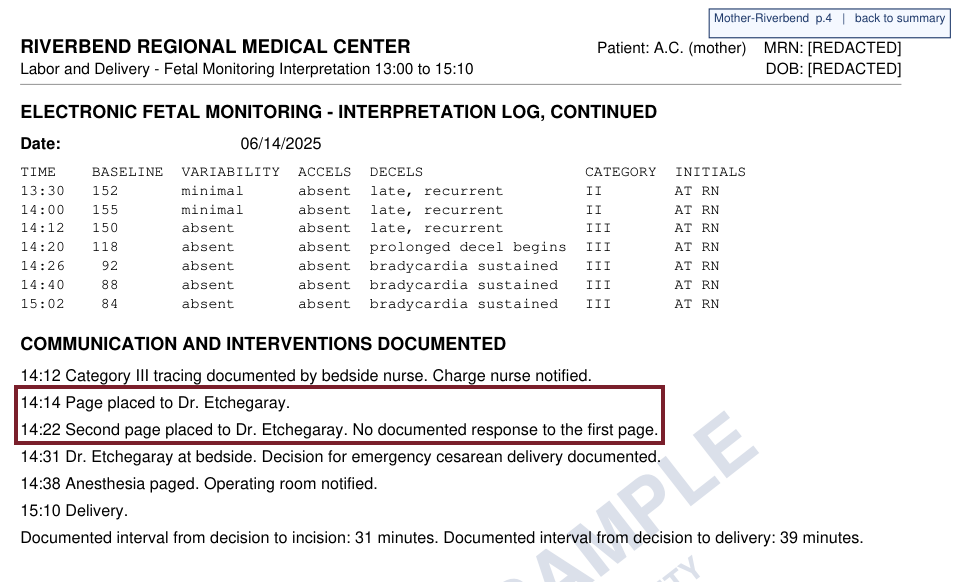
Every number, time and quotation on one carries the record page it came from. Every one of those page tags is a live link. Click it and the source page opens behind the exhibit, in the same file. Print it and you still have a clean panel. Display it and you have the record behind it.
That matters for one reason. Whoever puts the exhibit up doesn't have to defend a chart. They have to say it fairly and accurately depicts the record. Then the other side can check it, in the room, without taking anyone's word for it. That holds whether the person sponsoring it is a retained expert or you.
What I won't put on an exhibit: anatomy that isn't in your films, a threshold that isn't in the chart, or a clinical standard of any kind. Those belong to the witness qualified to state them. The exhibit's job is to show what the record says, and to prove where it said it.
You get two files. The exhibit with the cited source pages bound in behind it, which is the one you display. And a clean single panel for printing or mounting. Neither carries any branding of mine.
Two samples are on the samples page. They look nothing alike, which is deliberate. See the two exhibits.

There is no separate charge for this. Exhibits are rolled into the $1.00 per page rate. If I've read your records at a dollar a page, the exhibits built off those records are another deliverable off the same reading. Not a second invoice. Not an add on. Not a line item.
Before the records arrive. Send me a nursing home's name and the resident's dates of stay, or a carrier's USDOT number and the crash date. I pull what the federal government already publishes. For a facility, that's daily nurse staffing by quarter against its own expected hours, with the stay marked, plus survey deficiencies, penalties, star ratings and the ownership chain. For a carrier, it's the safety snapshot, every roadside inspection and out-of-service order, crash records and ratings. Every figure cites the dataset, its public address and the date I pulled it. It won't say that staffing caused anything, or that a carrier is unsafe. That's for your experts.
$500 per facility or carrier. $250 for each added facility in the same ownership chain.
Courts have excluded expert opinions because the underlying report cited articles that don't exist. Send me the report, its reference list and the records it cites. I check every citation: does the source exist, do the author, year and journal match, and does it say what the report says it says? I check every record cite against its page. Where the expert has spoken to the same point before, whether in a published opinion or article, I set it beside the report. You get a register with a status and a link for every citation. I don't say whether the opinions are right. Testifying experts can send their own draft before it's served. More for experts on the Experts page.
$500 flat per report, up to 50 references and 100 record cites. $10 for each added reference.
A few services are priced as flat fees, not per page:
| Service | Fee |
|---|---|
| Medical expert identification & vetting (finder's fee, payable only if the expert is retained) | $1,000 |
Pre-Suit Record Screen (72-hour turnaround)
| $500 |
| Public-record profile, per nursing home or motor carrier ($250 for each added facility in the same ownership chain) | $500 |
| Expert report citation audit, per report, up to 50 references and 100 record cites ($10 for each added reference) | $500 |
| Testimony list for a testifying expert, built from the expert's own records ($150 a year to keep it current) | $350 |
| Qualifications self-audit for a testifying expert ($150 a year to refresh it) | $350 |
| Case file register on its own (included with any per-page record order) | $150 |
| Deposition errata transcription check (included when I did the record work) | $150 |
| Ongoing case coordination | $1,000 / month |
Standard Terms
$1.00 per page to 10,000 pages in a matter, then $0.50 per page. $500 minimum per matter. With regard to initial client engagements, your first 500 pages are processed at no charge (no minimum). 50% to start, balance due on delivery. Same business day rush: add 50%. A "page" means one page of a document you send me for analysis. My own work product does not count toward your total. Work product goes out with no letterhead or branding of mine. If you'd like your firm's letterhead on it, send it along with the records and I'll add it at no charge.
This is a solo litigation support practice built on 30 years of complex litigation support experience and the systematic application of advanced A.I. workflows to case documentation. You hire me, and I do the work.
I work exclusively in civil litigation. That focus is deliberate. Every tool, every workflow, and every service I offer is designed for the specific demands of active case preparation, ranging from clerical to substantive and all points in between.
The practice specializes in medical-legal matters. Birth injury is the deepest part of that work, hypoxic ischemic encephalopathy in particular. It also covers medical malpractice generally, nursing home and elder abuse, trucking, toxic exposure, product liability, and serious personal injury. I also screen records before suit, and tell you what they support and what they lack. With regard to the clinical judgment questions, I assemble the record evidence against each of them and attach no opinion, because that's a job for a retained expert, not me. More broadly, I'll take on just about any document-intensive civil litigation matter up to roughly 100,000 pages. The work sits best between about 1,000 and 50,000 pages. Above 100,000 I'd point you to an e-discovery vendor rather than take a matter I can't do properly.
With respect to medical malpractice and other healthcare related litigation, I organize the record around the three issues your case turns on: standard of care, causation, and damages. For each, I show you where the record speaks and where it is silent, with a citation to every page. The opinions on those issues are your experts'. My job is making sure nothing in the record that bears on them gets missed.
I combine A.I. assisted document workflows with experienced litigation judgment. The A.I. handles volume. The judgment handles everything that actually matters: what's clinically significant, what's missing, what contradicts the opposing expert, what the timeline really shows. Every deliverable goes out with its citations in place, so nothing in it has to be taken on trust. The result is work product that arrives faster and holds up better under scrutiny, at a flat project fee priced before I start.
My name is David A. Black, and I have worked in complex litigation support for 30 years. Earlier in that run I was a Senior IP Paralegal Specialist and Electronic Evidence Liaison at the San Francisco and Palo Alto offices of Cooley Godward LLP (now Cooley LLP) and Gray Cary Ware & Freidenrich (now DLA Piper). I was also a project manager at OnPoint Analytics, a small Bay Area firm specializing in data analysis for testifying economists in high-stakes litigation in the early 2000s.
From 2020 through June 2026 I ran MedLegal Network, a medical expert witness vendor serving clients nationwide. For the past 15 years I have worked very closely with one of the most renowned child neurology medical expert witnesses in the U.S.
I earned a BA in Political Science from the University of California, San Diego, a master's in English Literature from San Francisco State University, and a California public school teaching credential from the University of San Francisco. I taught middle school in San Francisco as a young man.
Reputable artificial intelligence products are, with very few exceptions, incredible at getting much of your work done competently in a fraction of the time it takes a human being to do so. They read thousands of pages without tiring. They find the one lab value buried deep in a record. They draft a chronology in hours. I therefore use such tools daily and don't mind saying so.
Moreover, A.I. is evolving rapidly. What a model or agentic process could not do in January it does by June. Anything anyone tells you about their limits has a short shelf life. I re-test my own workflows as the tools change, because a method that was sound a year ago may now be obsolete.
Having said this, they are not infallible. And their perfection will likely never be achieved. A model can produce a citation to a source that does not exist. It can attribute a finding to the wrong date, the wrong physician, or a page that says something else entirely. It does this in fluent, confident prose that reads exactly like the right answer. Expert declarations have already been thrown out because the citations in them were invented by a model. Fluency is not accuracy. Linking A.I. claims to their corresponding source files, however, serves to catch the technology's imperfection.
This is why verification is not an option with respect to my work. It's a requirement. Every fact in a deliverable carries a citation to the source page from which it came, and where the work calls for it I bundle those cited pages into the deliverable itself. That turns what would otherwise be a mere assertion into a substantiated record. You do not have to take my word for any of it, and you do not have to take the machine's. You can click the citation and read the page.
I would never ask a client to accept work product generated by artificial intelligence without source file verification. Neither should you.
If A.I. technology reviews the records, what value do you bring to the process? A fair question, and I would rather answer it than have you wonder.
Deciding what to ask. The technology does not know which facts matter in your case, which gap in a chart is routine and which one is the case, or what the opposing expert is going to lean on. It cannot know. It has never met your file.
It also does not know where its own competence ends. It does not slow down, hedge, or flag the moment it crosses from something it handles well into something it does not. It produces the same confident prose either way. Knowing roughly where that line falls in a set of medical records is not a feature of the software. It is thirty years of reading medical records.
Consider what has happened in law specifically. A Stanford study published in the Journal of Empirical Legal Studies tested the leading commercial A.I. legal research products, the purpose-built ones sold to firms as the safe option. They produced incorrect or unsupported statements between 17 and 33 percent of the time, while being marketed as hallucination-free. If the tools built specifically for this still need someone checking them, so does everything else.
There is a line going around that the rise of artificial intelligence has effectively resulted in English majors' vindication. It is closer to true than it sounds. What these systems give back is governed by the precision of what you put in, and precision with language is a trained skill rather than a knack. In a controlled study, professionals and non-professionals were given the identical tool, the identical time limit and the identical task. The professionals got measurably better results because A.I.'s output is only as good as its input prompts.
Precision buys a second thing. The same records can be written up for a jury, for a lawyer, or for a physician, and those are three different documents. A juror needs the story in plain language. A litigator needs the timeline, the intervals and the gaps. Your retained expert needs the clinical detail and the citation behind every line. Tell me who is going to read it and what they need to do with it. That is the level I write to.
So, no. I am not a potted plant standing next to a machine that does the work. I decide what to ask. I decide what matters and what does not. And every answer comes back tied to the page it came from, so that you never have to take either of us on faith.
Start a matter. Tell me what you have and what you need. It takes about two minutes and I will come back with a fixed price and a delivery date. Do not send records through the form. Records come later, through a secure link.
Start a MatterUpload documents, imaging, and other case media here. Transfers are end-to-end encrypted, covered by a HIPAA Business Associate Agreement, and handled under your protective order. No account or sign-in required.
Transmit your records to me electronically. I do not accept any media in hard-copy format, though a USB drive can be arranged if the volume requires it. If your records are on paper, your copy service or scanning vendor can deliver them to my secure upload link in PDF format.
Upload Files and/or FoldersSend me the matter, the service you need, and an estimated page count. I respond the same day. Rush engagements are confirmed and scoped within hours.